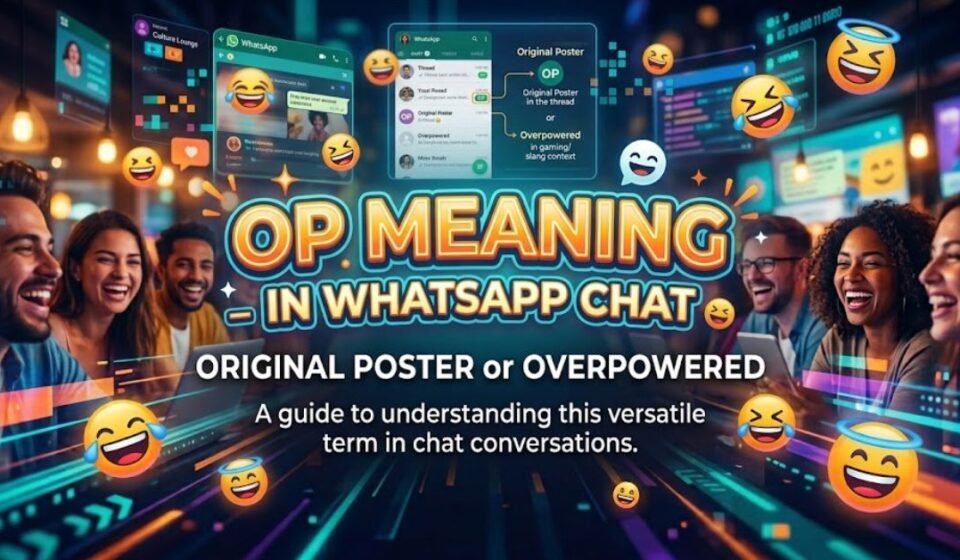
You saw someone type “OP” in a group chat and now you’re stuck guessing. Does it mean the person who started the thread? Or does it mean something is ridiculously strong?Here’s the short answer. OP usually stands for Original Poster in forums, Reddit, and online chat, and it stands for Overpowered in gaming and gaming slang. Same two letters, two completely different jobs, and the context tells you which one is talking.
This guide breaks down both meanings, shows you real examples from WhatsApp, Instagram, and Discord, and clears up the mix ups that trip people up daily. By the end, you’ll never have to guess again.
OP Meaning in Chat – Quick Meaning
In online conversations, OP is shorthand people use so they don’t have to type out full sentences every time. It saves keystrokes and it saves time, which is basically the whole point of internet slang.
On Reddit and other online forums, OP means the thread starter, the person who kicked off the discussion thread. Say “OP said this earlier” and everyone instantly knows you mean the original author of the post.
Flip over to gaming culture, and OP flips meaning too. There it means Overpowered, describing a weapon, character, or strategy that’s stronger than it should fairly be.
Simple Examples:
- “OP, can you explain your point again?” (Original Poster)
- “That new gun is so OP, they need to nerf it.” (Overpowered)
- “OP never replied to the comments.” (Original Poster)
- “Bro your build is OP AF right now.” (Overpowered)
Origin & Background
Slang doesn’t appear out of thin air. It grows out of real communities that needed a faster way to talk, and OP is a textbook case of that.
1. Forum & Reddit Era
Back in early internet forums, threads got long fast, and people needed a quick way to refer back to whoever posted first. Forum discussions picked up “OP” as shorthand, and Reddit later carried the habit into the mainstream.
It stuck because it’s efficient. Nobody wants to type “the person who made this post” fifty times in one thread.
2. Gaming Culture
Around the same time, competitive gaming communities were arguing over game balance constantly. Something felt unfair, someone called it “overpowered,” and gamers shortened it to OP because that’s what gamers do.
This meaning spread through gaming chat, strategy guides, and patch note discussions. It’s now standard gaming terminology across almost every title with a competitive scene.
3. Social Media Expansion
As social media grew, both meanings jumped platforms. TikTok, Instagram, and group chats absorbed the term from forums and gamers alike.
Today OP shows up in Instagram comments, TikTok comments, and everyday texting, carrying whichever meaning fits the moment. Context always does the heavy lifting.
Real-Life Conversations
Reading definitions is one thing. Seeing OP actually used in the wild makes it click faster.
1. WhatsApp Chat
In a WhatsApp chat, OP usually points back to whoever sent the original message in a group. Someone might say, “Wait, what did OP even ask?” when the conversation has drifted off topic.
It’s a handy way to redirect a chat without scrolling up fifty messages. Group admins use it a lot too, especially in busy family or work groups.
2. Instagram Comments
Scroll through Instagram comments on a viral post, and you’ll spot OP referring to the content creator who shared it. Comments like “OP really said that with confidence” show respect toward the original author.
Sometimes it’s used sarcastically too, which is where tone gets tricky, and we’ll cover that later.
3. Gaming Chat
In gaming chat, especially during multiplayer matches, OP almost always means Overpowered. A teammate might type “that boss is OP, watch out” mid battle.
Here it’s fast, functional slang meant to warn or hype up teammates in real time. There’s no room for long explanations mid match.
Emotional & Psychological Meaning
OP isn’t just a label. It carries a bit of emotional weight depending on how and where it’s used.
1. Recognition
Calling someone OP, especially the thread starter, gives them a small nod of recognition. It says, “I see you, you started this.”
That tiny bit of acknowledgment matters more than people realize in fast moving online communities.
2. Respect or Admiration
When OP means overpowered, it often carries genuine admiration. Calling a player’s skill “OP” is a compliment, a way of saying they’re dominating the game.
It works the same way in casual praise, like calling someone’s cooking or outfit “OP” as an exaggerated form of appreciation.
3. Efficiency in Communication
Beyond feelings, OP just makes communication skills sharper. It’s efficient communication at its core, packing meaning into two letters instead of a whole sentence.
That’s the real appeal behind most internet abbreviations. Faster typing, same message, less effort.
Usage in Different Contexts
Where you use OP changes what’s appropriate, and getting this wrong can make a message land oddly.
1. Social Media
On social media, OP flows naturally in comments, captions, and replies. It fits the casual, quick rhythm those platforms run on.
2. Friends & Relationships
Among friends, OP works as both meanings, and switching between them mid conversation is completely normal. Your friend group probably already does this without noticing.
3. Work or Professional Settings
Workplace communication is where OP gets shaky. In professional emails or reports, it can look unclear or too casual for the setting.
Stick to plain words like “the original sender” or “the author” in formal writing. Save OP for group chats and casual Slack messages instead.
4. Casual vs Serious Tone
The same word can sound playful or a bit sharp depending on delivery. “OP really said that” can be admiring or mocking, and only tone and conversation context tell you which.
Common Misunderstandings
Slang misfires happen constantly, and OP has a few classic ones worth knowing.
1. Thinking It Has Only One Meaning
The biggest mistake is assuming OP always means the same thing. Forget the setting, and you’ll misread the whole message.
2. Using It in Formal Writing
Dropping OP into formal communication or client emails reads as unprofessional. It’s built for casual spaces, not business documents.
3. Misreading Tone
Sarcasm is easy to miss in text. “Wow, OP” without emojis or context could be a compliment or a jab, and readers often guess wrong.
4. Using It Offline
Say “OP” out loud in a face to face chat, and you’ll probably get a confused look. It’s built for typing, not talking, so it rarely translates to spoken conversation.
Comparison Table
| Meaning | Where It’s Used | Example | Tone |
| Original Poster | Reddit, forums, group chats | “OP hasn’t replied yet” | Neutral or curious |
| Overpowered | Gaming, competitive play | “This weapon is OP” | Admiring or frustrated |
| OP AF | Gaming, casual chat | “That combo is OP AF” | Intense emphasis |
| OP Move | Any competitive context | “That was an OP move” | Impressed |
Variations / Types of OP
OP isn’t a one size fits all term. Here are the common flavors you’ll run into.
1. OP (Original Poster)
The classic forum meaning, referring to whoever started the thread or discussion thread.
2. OP (Overpowered)
The gaming slang meaning, describing something unfairly strong in game mechanics.
3. OP AF
An intensified version, adding emphasis to how overpowered something feels.
4. OP Skills
Used to praise a player’s gaming performance when they’re clearly outclassing everyone.
5. OP Move
A single standout play that felt unstoppable in the moment.
6. OP Content
Refers to a post, video, or update so strong it dominates conversation or gameplay.
7. OP Reply
A comeback or comment so sharp it shuts down the discussion instantly.
8. OP Strategy
A game plan considered too strong, often leading developers to consider a nerf.
9. OP Character
A game character with stats or abilities well above the rest of the roster.
10. OP Moment
A short burst of gameplay or conversation that felt impressively dominant.
How to Respond When Someone Uses It
Not sure how to reply when someone calls you or your move OP? Here are a few directions to take it.
Casual Replies
“Haha yeah I know, can’t help it” keeps things light and easy going, fitting most casual conversation.
Funny Replies
“OP? Me? Never heard of her” adds humor without overexplaining, which usually lands well in group chats.
Mature / Confident Replies
“Appreciate that, been practicing a lot” shows confidence without sounding boastful.
Private or Respectful Replies
In quieter one on one chats, a simple “thanks, that means a lot” feels more genuine than a joke reply.
Regional & Cultural Usage
Global internet usage has spread OP everywhere, but the flavor shifts slightly by region.
Western Culture
In Western culture, OP is used loosely and often jokingly, especially among younger internet users on Discord and Reddit.
Asian Culture
Asian culture, particularly in gaming heavy regions, uses OP heavily in competitive gaming talk, often tied closely to esports commentary.
Middle Eastern Culture
In Middle Eastern culture, OP shows up mostly through gaming communities and youth focused social media slang, following global gaming trends closely.
Global Internet Usage
Overall, OP has become close to a universal internet term, understood across most online platforms regardless of language barriers.
OP vs Other Popular Slang Terms
People often confuse OP with other short slang like “GOAT,” “W,” or “L.” GOAT praises someone as the greatest ever, while OP praises current dominance, often tied to a specific moment.
“W” and “L” mark wins and losses bluntly, without the nuance OP carries. OP sits in its own lane, blending praise, recognition, and sometimes light criticism depending on delivery.
FAQs
1. What does OP mean in chat?
It usually means Original Poster, the person who started a conversation or thread.
2. Is OP a compliment?
Often yes, especially when it means Overpowered and points to impressive skill or content.
3. Can OP be negative?
Yes, in gaming it can signal frustration when something feels unfairly strong and needs a nerf.
4. Is OP formal or informal?
Strictly informal, meant for casual messaging, not professional communication.
5. What does OP mean in gaming?
It means Overpowered, describing a character, weapon, or strategy that’s too strong compared to others.
6. What does OP mean on social media?
Mostly Original Poster, referring to whoever shared the original content people are commenting on.
7. Should I use OP in professional emails?
No, avoid it in email etiquette and stick to clear terms like “the original sender” instead.
Conclusion
OP carries two lives online, one as Original Poster and one as Overpowered, and context always decides which one you’re reading. Once you know the setting, whether it’s Reddit, WhatsApp, or a gaming match, the meaning becomes obvious fast.
Try spotting it in your next chat and see which version fits. Drop a comment below with the funniest OP moment you’ve seen, chances are someone else has a similar story.

Matt Henry is a writer and researcher at Trexoleen, specializing in text meanings, slang, abbreviations, acronyms, and modern internet language. He is passionate about making confusing terms simple and easy to understand.