
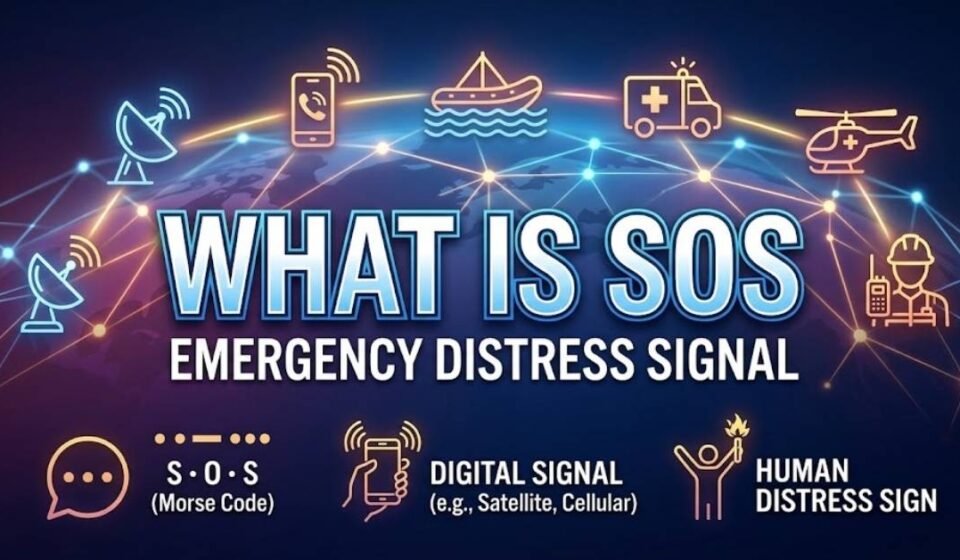
You saw “SOS” in a text and paused for a second. Is it serious? Is your friend okay? Or are they just being dramatic about a coffee spill?Here’s the short answer: SOS doesn’t officially stand for anything. It’s an international distress signal, chosen because it’s easy to send and impossible to miss in Morse code.
Today it means “I need help, now,” whether that’s a sinking ship or a dead phone battery before a big presentation.Let’s break down where it came from, how people use it today, and why it still grabs attention faster than almost any other word in the English language.
What Does SOS Stand For? Quick Meaning
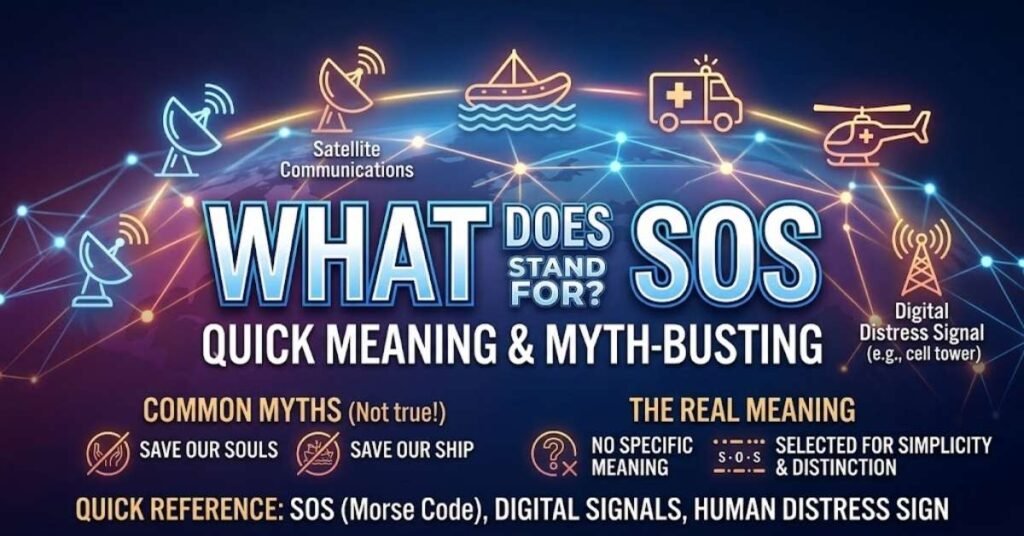
SOS is not an acronym in the traditional sense. It doesn’t spell out “Save Our Souls” or “Save Our Ship,” even though those phrases got attached to it later as memory tricks.
The real story is simpler. Radio operators needed a distress signal that was easy to tap out and hard to confuse with anything else. Three dots, three dashes, three dots, written as … — …, became that signal, and SOS was just the letters that matched the pattern.
So when someone asks “what does SOS stand for,” the honest answer is: it stands for urgency. It’s less about the letters and more about what they trigger in your brain the moment you see them.
Simple Examples
Picture these everyday situations and you’ll get the idea fast.
- A hiker loses the trail and taps out SOS on a satellite messenger.
- A friend texts “SOS, need advice before I hit send on this email.”
- A student messages a group chat, “SOS, assignment due in an hour and I haven’t started.”
None of these involve an actual ship or ocean. That’s the point. SOS travels well because it’s short, loud, and instantly understood.
Origin and Background of SOS
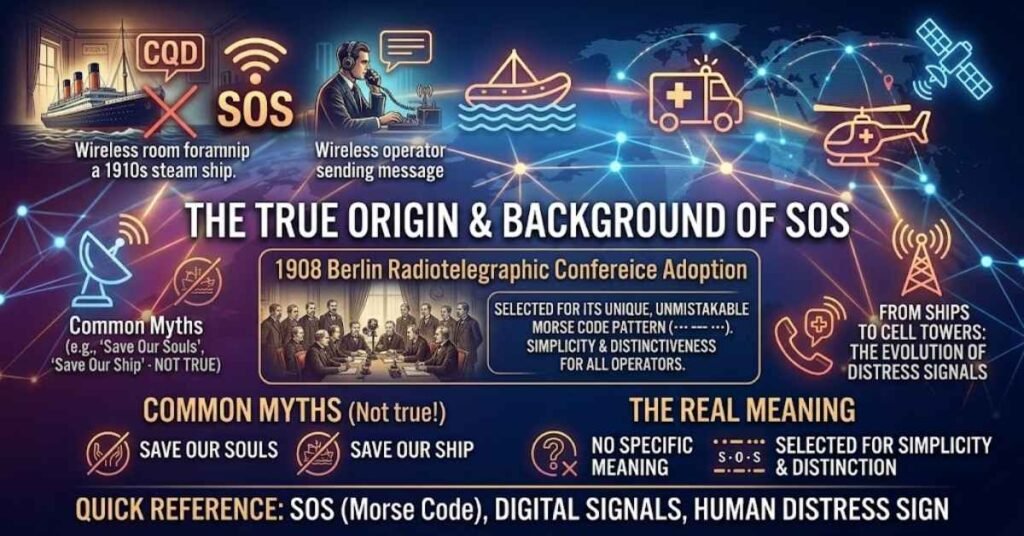
The story of SOS starts with early wireless telegraph systems in the early 1900s. Ships at sea needed a way to call for emergency assistance when things went wrong, and Morse code was the tool available at the time.
Before SOS, there were other distress codes floating around, like CQD, which some ships used. But CQD was clunky to send and easy to mix up with regular signals. International communication authorities wanted something cleaner, so in 1906 they agreed on … — … as the standard maritime distress call.
Here’s the twist most people miss: SOS was picked for its rhythm, not its meaning. It has no natural break in the pattern, so it stands out clearly even through static or a shaky hand on the telegraph key. That’s the entire secret behind why this three-letter combo became the universal distress signal we still recognize today.
Real-Life Conversations Using SOS
Forget ships for a second. This is where SOS actually lives now, in your phone.
People use it constantly in casual chats, and honestly, half the time it has nothing to do with real danger. It’s become a stand-in for “drop everything and help me,” whether the stakes are high or laughably low.
Here’s how it shows up across different apps.
WhatsApp Conversation

Maya: SOS, my landlord just texted about the rent 😩 Priya: omg what happened Maya: nothing bad yet, just need advice on what to say back
Instagram DM
Zara: sos i need an outfit opinion in 5 mins Leo: send pics now, I got you
TikTok Comments
@user2201: SOS why is this recipe not working 😭 @chefkate: you probably overmixed the batter, happens to everyone
Text Message
Dad: SOS, car won’t start, can you look up a tow truck number?
Notice the pattern. Each one uses SOS to skip the small talk and get straight to the point. That’s the real value of the word now: it saves time in a conversation, not just lives at sea.
Emotional and Psychological Meaning of SOS
There’s more going on here than just an old emergency signal. When someone types SOS, they’re often signaling stress, overwhelm, or plain frustration, even if the situation itself is minor.
Think about the last time you felt truly stuck, maybe buried under exam stress or an assignment deadline with no end in sight. Typing “SOS” to a friend is quicker than explaining the whole mess, and it still gets the message across. It’s a shortcut for vulnerability, a way to say “I need support” without sounding weak or dramatic.
That’s why the word carries weight even in low-stakes moments. It taps into a shared understanding that help should arrive fast, no questions asked first, explanations later.
Usage in Different Contexts
Context changes everything about how SOS lands. A text from your boss reads very differently than a text from your best friend, even with the exact same three letters.
Social Media
On platforms like Instagram and TikTok, SOS often shows up in captions or comments asking for quick input. “SOS, which filter looks better?” is a normal sight, and nobody assumes an actual emergency is happening.
Friends and Relationships
Among friends, SOS usually means emotional support is needed, not physical rescue. It might be relationship drama, a tough decision, or just needing someone to talk it through with.
Work and Professional Settings
In work chat or internal team chats, SOS tends to mean something closer to urgent, but still professional. “SOS, the presentation file won’t open before the client call” is a classic example that keeps things moving without panic.
Casual vs. Serious Usage
The line between casual and serious usage depends entirely on tone and history with the person. A close friend can tell the difference between “SOS, bring snacks” and “SOS, I’m not okay,” usually within seconds.
Common Misunderstandings About SOS
A lot of people carry around wrong ideas about this little word. Clearing them up actually makes you appreciate the history more.
Mistake 1: Thinking SOS Means “Save Our Souls”
This is the most common myth out there, and it’s simply not true. Save Our Souls and Save Our Ship were created afterward as memory aids, not the original meaning.
Mistake 2: Assuming It Is Always Serious
Plenty of people panic when they see SOS pop up in a chat. Most of the time, it’s about a small crisis, like a phone battery dying or Netflix recommendations gone wrong.
Mistake 3: Using It During Formal Announcements
Dropping “SOS” into a formal email or professional announcement can look unprofessional. It works fine in casual text message threads, but formal settings usually call for clearer language.
Mistake 4: Ignoring Context
Reading SOS without checking the situation around it can lead to overreacting or underreacting. Always glance at the conversation before assuming the worst or brushing it off completely.
SOS Compared With Similar Terms
SOS isn’t the only way people ask for help, so it helps to see how it stacks up.
| Term | Common Setting | Urgency Level |
| SOS | Texting, social media, maritime | Flexible, casual to serious |
| Mayday | Aviation, radio communication | Always serious |
| Help | Everyday speech | Depends on tone |
| Rescue Me | Casual or playful | Usually light-hearted |
Key Insight
Mayday is reserved almost exclusively for real emergency situations in aviation and maritime communication. SOS, on the other hand, has stretched far beyond its original use and now covers everything from a financial SOS to needing outfit advice in a rush.
Variations and Types of SOS
People have adapted SOS to fit almost every corner of modern life. Here are ten you’ll actually recognize.
1. Emergency SOS
The classic version, built into most smartphones now as an actual emergency SOS feature for real danger.
2. Digital SOS
Used in online communication when someone needs quick tech help or a fast reply.
3. Friendship SOS
A call for backup when a friendship hits a rough patch or needs quick support.
4. Relationship SOS
Sent when relationship advice is needed urgently, often after an argument or tough conversation.
5. Workplace SOS
Common in professional communication when a deadline or task suddenly turns urgent.
6. Travel SOS
Used during a travel emergency, like a missed flight or lost luggage.
7. Financial SOS
Sent when money problems hit unexpectedly and quick advice is needed.
8. Emotional SOS
A quieter cry for emotional support, often between close friends or family.
9. Parenting SOS
Used for those chaotic parenting challenges that need a second opinion fast.
10. Academic SOS
Common among students facing an assignment deadline or last-minute exam panic.
How to Respond When Someone Uses SOS
Getting an SOS text puts the ball in your court. How you respond actually matters.
Casual Replies
“On it, give me two minutes.” “Say less, I got you.”
Funny Replies
“Captain, we’re on our way 🚀” “Emergency snacks incoming.”
Mature and Confident Replies
“I’m here, tell me what’s going on.” “Take a breath, we’ll figure this out together.”
Private and Respectful Replies
“Are you okay? Want to talk privately?” “Would you like to talk, or just need a distraction right now?”
Reading the room before you reply shows you actually get how the person is feeling, not just the words they typed.
Regional and Cultural Usage
SOS travels across borders differently depending on where you are.
Western Culture
In North America and Europe, SOS shows up constantly in texting and social media, mostly for light, everyday situations.
Asian Culture
Across parts of Asian culture, SOS is used similarly online, though it often carries slightly more weight in formal messaging.
Middle Eastern Culture
In Middle Eastern culture, the term appears frequently in digital slang among younger generations, following global internet trends closely.
Global Internet Usage
Across the board, global internet usage has turned SOS into a shared symbol that needs no translation, a rare thing in modern slang.
Why SOS Still Works After More Than a Century
It’s worth asking why this old Morse code signal hasn’t faded out like other historical terms. The rhythm of … — … is baked into pop culture, movies, and even emoji shorthand, keeping it alive without much effort.
Unlike newer slang that fades within a year or two, SOS carries genuine history behind it. That history gives it weight, even when it’s used for something as small as a missing charger cable.
FAQs
Does SOS actually stand for anything?
No, SOS doesn’t officially stand for any specific words. It was chosen purely for its clear, unmistakable Morse code pattern.
Is SOS short for “Save Our Souls”?
Not originally. Save Our Souls was a phrase people attached later to help remember the letters, not the true origin.
Why is SOS so famous?
Its simple rhythm made it the most recognizable distress signal worldwide, and it stuck around through radio, film, and now texting.
Is SOS still used today?
Yes, it’s still an active emergency signal in maritime and aviation settings, and it’s thriving as casual slang in texting and social media.
What does SOS mean in texting?
In SOS in texting, it usually signals “I need help or advice right now,” ranging from serious to completely lighthearted.
Is SOS always serious?
No, context decides that. A text from a close friend can mean anything from real distress to a snack emergency.
What is the difference between SOS and Mayday?
Mayday is strictly for real emergencies in aviation and radio use, while SOS covers a much wider, more flexible range of situations.
Conclusion
SOS started as a practical solution to a technical problem on the high seas. Somewhere along the way, it turned into one of the most flexible words in modern language, stretching from actual maritime emergency calls to a friend needing outfit advice before a date.That flexibility is exactly why it still matters.
Next time you see SOS pop up on your screen, you’ll know exactly where it came from, and you’ll know it’s worth a quick reply either way.Got your own SOS story? Drop it in the comments, someone out there probably needs the laugh or the advice.

Matt Henry is a writer and researcher at Trexoleen, specializing in text meanings, slang, abbreviations, acronyms, and modern internet language. He is passionate about making confusing terms simple and easy to understand.