
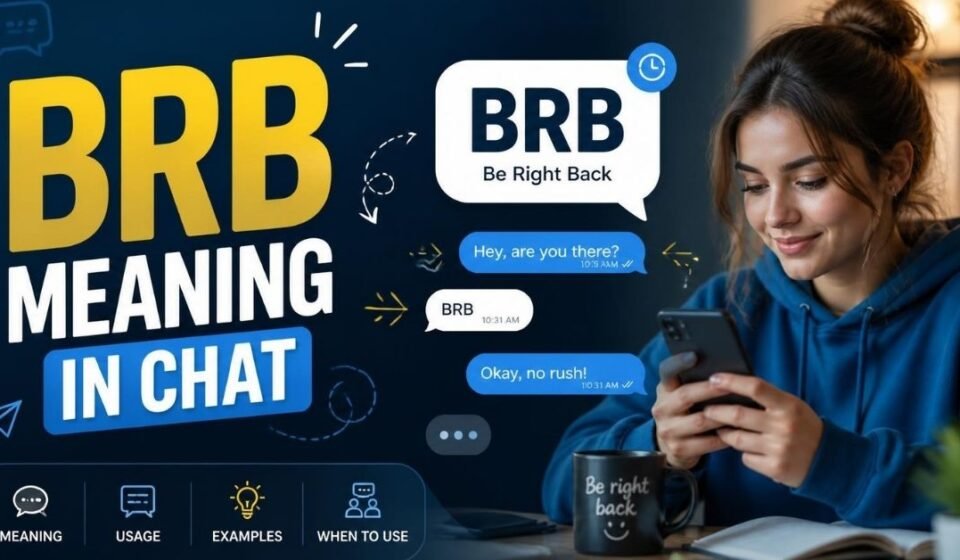
BRB means “Be Right Back.” That’s the whole answer in five words.It’s one of the oldest pieces of internet slang still in daily use.People type it when they’re stepping away from a chat for a bit, whether that’s two minutes or twenty.
You’ve probably typed it a hundred times without thinking twice about where it came from or why it still works.Stick around, because this text abbreviation carries more history and etiquette than most people realize.
BRB – Quick Meaning
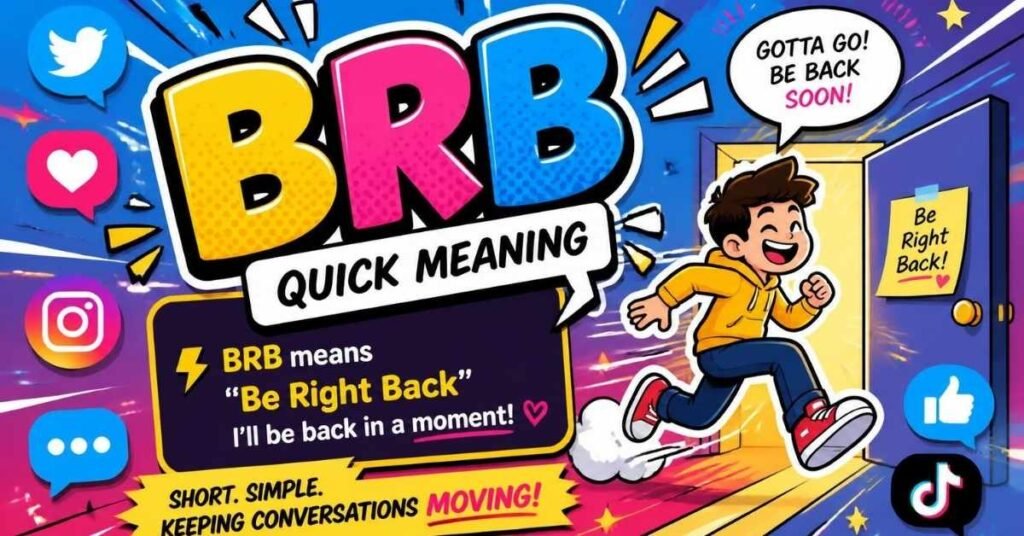
BRB is short for “Be Right Back.” It tells the other person you’re leaving the chat for a short while.
You’ll see it in WhatsApp chat, texts, gaming lobbies, and even work group chats where people keep things casual.
It’s not a formal signal. It’s more like a quick tap on the shoulder that says “hang on a sec.”
Think of it as a conversation pause button. You hit it, step away, and come back when you’re done.
No drama, no long explanation needed. Just three letters doing the job of a full sentence.
Simple Examples
Here’s how BRB shows up in real text messages and chats:
- “BRB, someone’s at the door.”
- “brb 2 mins, gotta grab water.”
- “BRB, phone call.”
- “brb real quick lol”
Notice how none of these sound stiff. That’s the whole point of this kind of online shorthand.
Origin & Background

BRB didn’t start on Instagram or WhatsApp. It goes way back to the early days of the internet.
Chatrooms on platforms like AOL and MSN Messenger needed fast ways to signal you were stepping away from your screen.
Back then, internet connections were slow, computers were shared with family, and typing speed mattered a lot more than it does now.
If someone needed the phone line or the computer, you didn’t have time to type out a paragraph explaining yourself.
So short forms like BRB, AFK, and LOL became the backbone of early online communication.
These weren’t invented by any single person. They grew organically out of chatrooms and online forums where speed mattered more than grammar.
Over the decades, this bit of internet history stuck around and adapted to every new platform that came along.
Real-Life Conversations (How People Actually Use BRB)
Theory is nice, but seeing BRB in action makes it click faster. Let’s walk through how it shows up across different apps.
Every platform has its own little flavor of using this chat acronym, even though the meaning stays exactly the same.
1. WhatsApp Chat
On WhatsApp, BRB often comes with a reason attached, since most chats there are with people you actually know well.
Something like: “brb, mom’s calling me” feels normal and doesn’t need any explanation beyond that.
Group chats on WhatsApp use it constantly too, especially when someone’s juggling multiple conversations at once.
2. Instagram DMs
Instagram DMs tend to be more relaxed and quick, so BRB shows up without much context at all.
A simple “brb” with no punctuation is common here. People move fast and don’t overthink these little chat examples.
Story replies and comment threads borrow this same casual energy, especially among younger users.
3. Text Message
Regular text chat on your phone uses BRB the same way it always has, just with less typing effort involved.
You’ll see it paired with emojis sometimes, like “brb 🏃” to add a bit of personality to an otherwise plain message.
It keeps the conversation flow going without leaving the other person hanging or confused.
4. Gaming Chat
Gaming chat is where BRB really earns its keep. Matches move fast, and stepping away mid game needs a quick heads up.
Players in Discord voice channels or in game text boxes type “brb” before muting themselves or pausing to grab a snack.
It’s practically a rule of etiquette in online gaming circles. Ghosting your team without a word is considered rude.
Emotional & Psychological Meaning

BRB isn’t just functional. It carries a bit of emotional weight too, even if nobody consciously thinks about it that way.
Saying it, instead of just vanishing, sends a small signal about how much you value the person on the other end.
1. Respect for the Conversation
Typing BRB shows respect for the conversation instead of leaving someone wondering if you got bored or annoyed.
It’s a tiny gesture, but it keeps trust in communication intact, especially in newer friendships or work relationships.
2. Digital Politeness
This ties directly into digital politeness. Ghosting mid chat without warning can feel dismissive, even if that’s not the intention.
BRB softens that gap. It’s basically the online version of saying “excuse me” before you step out of a room.
3. Need for Flexibility
Life doesn’t pause for chats. Kids need attention, food burns, phones ring. BRB gives people flexibility without breaking the thread.
It acknowledges that multitasking is normal now, and nobody expects undivided attention through an entire conversation anymore.
4. Informal Connection
BRB also signals an informal connection. You wouldn’t type this to your bank’s customer service line, and that’s exactly the point.
It says “we’re comfortable enough that I don’t need to explain myself in detail.” That’s a small but real form of closeness.
Usage in Different Contexts
Not every chat calls for the same tone, and BRB adjusts depending on where and who you’re talking to.
Context changes everything here, from a group chat with friends to a quick note in a work chat.
1. Social Media
On social media chats, comments, and live chats, BRB is used loosely and often without any explanation at all.
Nobody expects a reason. People just accept it and move on with their scrolling.
2. Friends & Relationships
Between friends, BRB is second nature. You don’t overthink it, and neither does the person reading it.
Online friendships run on this kind of shorthand daily, and it barely registers as anything worth noting.
3. Work or Professional Settings
Professional communication is where BRB gets tricky. In team chat tools like Slack, it’s usually fine among coworkers you know well.
But in a professional email or a client facing thread, it can come across as too casual or even careless.
Stick to phrases like “I’ll step away for a moment” in formal communication when the audience calls for more polish.
4. Casual vs Serious Tone
The line between casual tone and serious tone usually comes down to relationship and platform, not the words themselves.
A good rule of thumb: if you’d use slang face to face with that person, BRB works fine in text too.
Common Misunderstandings
BRB seems simple, but a few mix ups happen often enough to be worth clearing up right here.
1. Thinking BRB Means “I’m Gone for Long”
Some people assume BRB signals a long absence. It doesn’t. It implies a short break, not hours of silence.
If you’re stepping away for a while, saying “gtg for a bit” or explaining the situation avoids confusion.
2. Using It Without Returning
This one annoys people the most. Typing BRB and then vanishing for the rest of the day breaks trust in communication fast.
If plans change, a quick follow up message keeps things honest and avoids leaving someone checking their phone for nothing.
3. Using It in Formal Situations
Dropping BRB into a formal professional communication setting, like a client call recap email, can look unpolished or unprepared.
Save the slang for chats where the tone already leans casual and informal.
4. Overusing It
Typing BRB every two minutes in the same conversation gets old fast and can feel scattered or unfocused.
Use it when you genuinely need a brief interruption, not as a filler word in every other message.
Comparison Table
Here’s a quick side by side of BRB against its closest cousins in online abbreviations.
| Term | Full Form | Meaning | Typical Use |
| BRB | Be Right Back | Stepping away briefly | Chats, gaming, calls |
| AFK | Away From Keyboard | Not at the computer | Gaming, forums |
| BTW | By The Way | Adding extra info | Any chat context |
| GTG | Got To Go | Leaving the chat soon | Ending conversations |
| TTYL | Talk To You Later | Ending chat for the day | Closing a conversation |
Key Insight
BRB and AFK often get mixed up, but they’re not identical. BRB usually means a short, active break within a live chat.
AFK leans more toward gaming and forums, signaling you’ve physically left your device, sometimes for a longer stretch.
Knowing this small difference helps you pick the right abbreviation usage depending on the situation you’re actually in.
Variations / Types of BRB (Common Forms)
People rarely type just “BRB” anymore without adding a little flavor to it. Here are common BRB variations you’ll spot daily:
- BRB 2 mins – a quick, timed break
- BRB real quick – informal and fast
- BRB one sec – super short pause
- BRB back soon – vague but reassuring
- BRB urgent – something needs immediate attention
- BRB phone call – specific reason given
- BRB grabbing food – casual, relatable context
- BRB gotta check something – curiosity driven pause
- BRB lol – playful, no real explanation needed
- BRB wait for me – asking the other person to stay put
Each version adds a bit of personality while keeping the core meaning exactly the same.
How to Respond When Someone Uses BRB
Replying to BRB doesn’t need to be complicated, but the tone of your response can match the vibe of the chat nicely.
Casual Replies
- “kk”
- “no worries”
- “take your time”
- “okay, waiting”
Funny Replies
- “don’t leave me hanging lol”
- “brb energy is strong today”
- “sure, go save the world”
Mature / Confident Replies
- “sounds good, I’ll be here”
- “take care of it, message me when you’re back”
- “no rush at all”
Private or Respectful Replies
- “okay, take the time you need”
- “I’ll wait, no pressure”
- “message me whenever you’re ready”
These small chat responses keep the conversation continuity alive instead of leaving a message on read with no reply at all.
Regional & Cultural Usage
Cultural usage of BRB isn’t identical everywhere. It shifts slightly depending on region and communication habits.
Western Culture
In Western culture, BRB is used freely across almost every messaging app, from texts to Discord servers without much thought.
Asian Culture
In Asian culture, younger generations use BRB heavily online, though formal messaging in professional settings still leans more polite and structured.
Middle Eastern Culture
Middle Eastern culture often blends BRB with local expressions, especially in mixed language chats among younger, connected users.
Global Internet Usage
Despite these small differences, BRB has basically become a universal online language understood across almost every country with internet access.
That’s what makes it one of the most recognized pieces of global internet usage even decades after it first appeared.
Conclusion
BRB is simple on the surface: three letters meaning “be right back.” But it carries real weight in how we manage online etiquette.It respects the other person’s time, keeps conversations flowing, and adapts smoothly across messaging platforms, cultures, and even generations of internet users.
Next time you type it, you’ll know exactly why those three letters have survived since the early days of online communities.
FAQs
1. What does BRB mean in texting?
BRB means “Be Right Back.” It signals you’re stepping away from the chat for a short while.
2. Is BRB rude?
Not at all. It’s actually more polite than vanishing from a chat without any warning or explanation.
3. Can I use BRB in professional messages?
It depends. Casual team chat with close coworkers is fine, but formal client emails should avoid it.
4. How long does BRB usually mean?
Typically a few minutes to under an hour. It’s meant for short breaks, not extended silence.
5. What’s the difference between BRB and AFK?
BRB usually means a quick, active pause. AFK often signals stepping away from the device for longer.
6. Do people still use BRB today?
Yes. It’s still widely used across texting, gaming, and social media, even with new slang constantly emerging.
7. Can BRB be used in voice chats?
Absolutely. People say “brb” out loud in Discord or gaming voice channels just as often as they type it.

Matt Henry is a writer and researcher at Trexoleen, specializing in text meanings, slang, abbreviations, acronyms, and modern internet language. He is passionate about making confusing terms simple and easy to understand.