

You’re typing an email to a new client. You want to mention how well the call went, and then it hits you. Is it “repore” or “rapport”?
Don’t worry, you’re not alone. This word trips up native speakers and learners alike. Let’s sort it out once and for all.
Repore or Rapport – Quick Answer
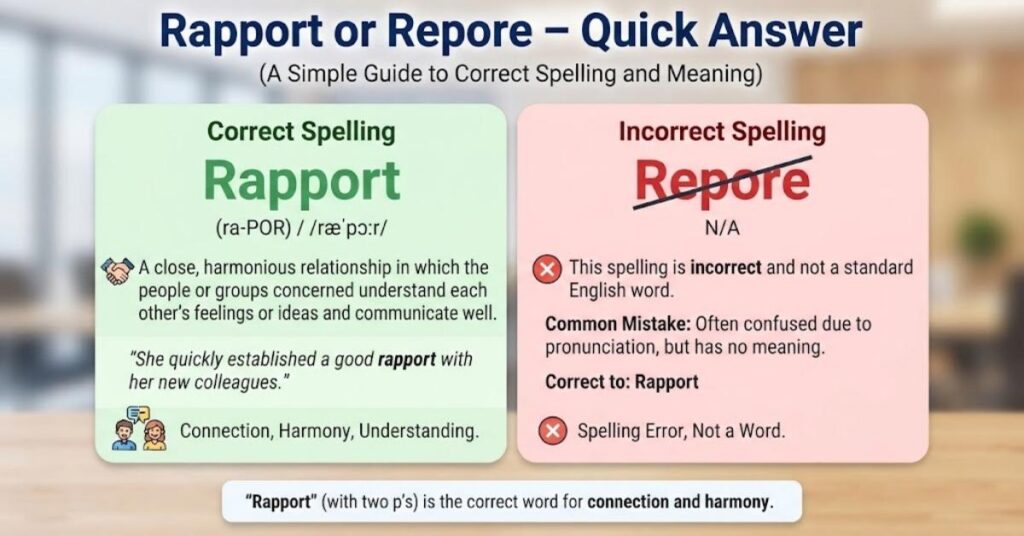
Rapport is the correct spelling. Repore is an incorrect spelling and a common misspelling that comes from how the word sounds. You won’t find it in any standard English dictionary.
The word means a close relationship built on trust and mutual understanding. You’ll see it in phrases like “build rapport with clients” or “we had instant rapport.”
Here’s the short version you can screenshot:
- Correct: rapport
- Incorrect: repore
- Pronunciation: ra-POUR
- Meaning: a friendly connection where people understand each other
The Origin of Repore or Rapport

English borrowed this word from French. In French language, rapport means a connection, a report, or a yield. It comes from the verb rapporter, which means to bring back or to relate.
Think of it this way. When two people have rapport, something travels between them and comes back. A smile, a joke, a shared idea. That back and forth is the heart of the word origin.
Many borrowed words keep their French spelling even after English adopts them. That’s why rapport carries a silent “p” and a silent “t” at the end. The etymology explains the strange look, but it doesn’t explain why “repore” feels so natural to type.
Why Do People Write Repore? The Sound Trap
Here’s the real culprit. English speakers spell by sound, and the sound of this word doesn’t match its look. We call this sound-to-spelling confusion.
Say it out loud: ra-POUR. The final “t” stays quiet, so the ending sounds like “pour” or “pore.” Your brain fills in the letters it knows, and “repore” shows up on the screen.
This is phonetic spelling at work. It’s a phonetic mistake, not a sign you’re bad at English. Foreign words with silent letters fool almost everyone at some point.
British English vs American English Spelling
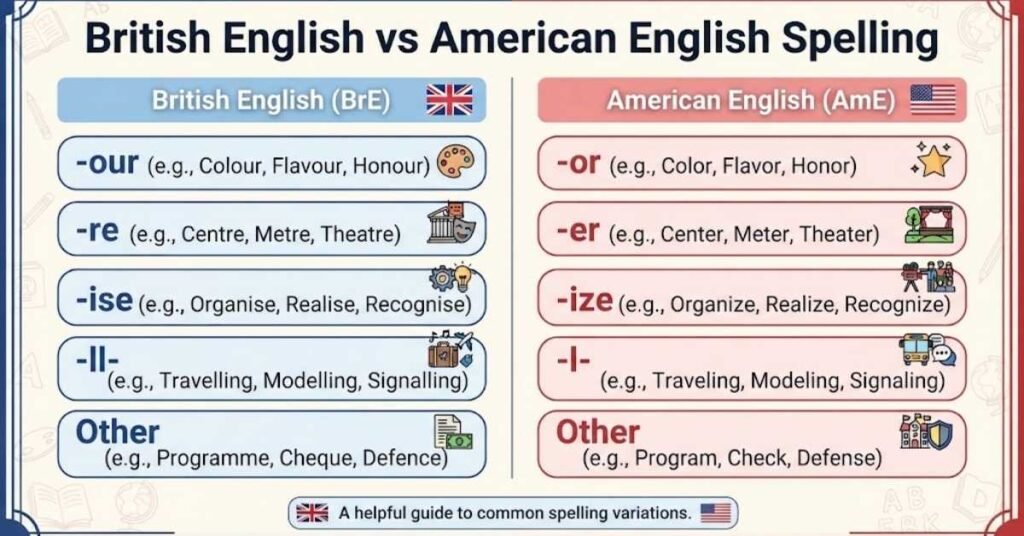
Good news here. There’s no split between British English and American English. Both UK English and US English use the same spelling: rapport.
You won’t find a “rapour” like “colour” or “colur.” Commonwealth English follows the same rule. So whether your readers are in London, Lagos, or Los Angeles, the spelling stays put.
What does change a little is pronunciation. Many Americans say “ra-POR,” while many British speakers say “ra-PAW.” These are pronunciation differences, not spelling differences. Both sound fine to a UK audience and a US audience.
Which Spelling Should You Use?
Always use rapport. That goes for formal writing, informal writing, and everything in between. There’s no setting where “repore” counts as acceptable Standard English.
Picture a job seeker who writes “I build strong repore with teams” on a resume. A hiring manager spots it in two seconds. Fair or not, it chips away at credibility and professionalism.
When you spell it right, you look confident and fluent. It’s a tiny detail that signals care. Readers notice, even when they don’t say so.
What Does Rapport Actually Mean?
Let’s go beyond spelling for a moment. Rapport meaning is simple: a positive relationship between people based on understanding and trust. It’s that feeling when a conversation just flows.
You can’t fake it for long. People sense harmony or the lack of it pretty fast. That’s why the word shows up so often in communication advice.
Is it formal or informal? It sits comfortably in the middle. You can use rapport in a board report or in a chat with a friend, and it won’t sound stiff.
Rapport in Psychology and Counseling
In psychology, rapport is a big deal. Therapists work hard to build it early because the therapeutic relationship shapes everything that follows. Without it, clients rarely open up.
A counseling session often starts with small talk for this exact reason. A calm voice, steady eye contact, and genuine curiosity help create an emotional connection. Trust grows slowly, and then all at once.
Therapy communication depends on feeling safe. That’s why you’ll see rapport in counseling textbooks, training manuals, and academic journals. And yes, they all spell it correctly.
Rapport in Business, Sales, and Leadership
Now let’s talk about the workplace. Business communication runs on relationships, and rapport sits at the center. Salespeople know this better than anyone.
Say you’re about to pitch a new idea. Chatting for two minutes about your prospect’s weekend can do more than a perfect slide deck. That’s rapport before pitching, and it works.
Leadership leans on it too. A manager with strong rapport with a team gets honest feedback sooner. HR teams also look for it when hiring, because skills matter, but fit matters just as much.
Rapport in Education and Healthcare
Walk into any good classroom and you’ll feel it. The teacher-student relationship shapes how much learners take in. Teachers who build rapport with students see more questions, more effort, and fewer behavior problems.
Healthcare works the same way. Patients tell nurses and doctors more when they feel heard. Better information leads to better care.
Even diplomacy relies on it. Leaders from different countries spend time on small talk before tough negotiations. Call it relationship building at the highest level.
Common Mistakes with Repore or Rapport
Let’s get practical. Most common spelling errors with this word fall into a few buckets. Knowing them helps you catch a slip before you hit send.
- Repore: the classic phonetic mistake
- Rapor: dropping one “p” and the “t”
- Raport: keeping the “t” but losing a “p”
- Rapour: borrowing the “our” ending from British words
- Rappor: doubling the first “p” instead of the second
Notice a pattern? Each one tries to match the sound. None of them match the dictionary spelling.
Another spelling confusion shows up with grammar. People write “report” when they mean rapport, since the two words share a French root. A “good report with clients” means something very different from a good rapport with clients.
How to Remember the Correct Spelling
Here’s a memory trick that sticks. Split the word into rap and port. Two short words, glued together.
Then remember the double “p” and the “t” at the end. A silent letter still belongs on the page. Think of it as a quiet teammate who still shows up to work.
Want another trick? Say it the French way in your head: rah-PORT. Spell it that way, then say it normally. It’s a small habit that protects you from the red underline later.
Repore or Rapport in Everyday Examples
Seeing the word in action helps more than any rule. Here are real-world style sentences you can borrow.
Emails
- “It was great to meet you. I really enjoyed the great conversation and the instant rapport.”
- “I’d love to build rapport with clients through regular check-ins.”
Resumes and LinkedIn profiles
- “Known for building rapport quickly with new teams.”
- “Skilled in rapport with clients across healthcare and sales.”
Everyday talk and social media
- “We had great energy from the first minute. Total rapport.”
- “She has a strong rapport with students, and it shows.”
News and politics
- “The candidate worked hard on rapport with voters during the tour.”
You’ll spot the same pattern each time. The word is a noun, and it pairs nicely with verbs like build, establish, and create. That’s why you’ll hear establishing rapport and creating rapport so often.
How to Build Rapport: Simple Steps That Work
Since you’re here, let’s make this useful beyond spelling. Rapport skills are learnable, and they boost your interpersonal communication fast. Try these steps.
- Start with something real. Skip generic openers and ask about something specific.
- Listen more than you talk. People remember how you made them feel.
- Match the energy. If your client is relaxed, don’t barrel in with a hard sell.
- Find common ground. A shared hobby or hometown works wonders.
- Follow up. A short note a week later keeps the connection alive.
None of this requires fancy communication skills. It needs attention and a bit of patience. Good relationship-building doesn’t happen overnight.
Repore or Rapport – Google Trends & Usage Data
Let’s talk about search behavior. When people type a search query like “repore or rapport,” they usually want one thing: a fast, clear answer. That’s the search intent behind it, and it’s why a Quick Answer near the top matters so much.
Instead of guessing at search volume numbers, I’d rather point you to the source. Open Google Trends, compare “rapport” with “repore,” and set the region to worldwide searches. You’ll see “rapport” dominate by a wide margin, while the misspelling shows up as a tiny line near the bottom.
That gap tells you something useful. Published sources, edited English, and dictionaries all use rapport. The misspelling lives mostly in quick typing and casual drafts.
Comparison Table: Keyword Variations
Here’s a quick look at the most common keyword variations and where each one stands. Keep it handy next time you proofread.
| Variation | Status | Why People Write It | Fix |
| Rapport | Correct | Follows French spelling | Use it everywhere |
| Repore | Incorrect | Spelling by sound | Replace with rapport |
| Rapor | Incorrect | Skips silent letters | Add the double “p” and “t” |
| Raport | Incorrect | Drops one “p” | Restore the second “p” |
| Rapour | Incorrect | Copies “our” endings | Use “port” |
| Report | Different word | Similar sound | Check your meaning |
Notice how only one row earns a green light. That’s all you need to remember.
Does Spellcheck Catch It?
Mostly yes. A modern spell checker will flag “repore” with a red underline right away. It usually suggests rapport, which makes fixing it easy.
But spellcheck has limits. It won’t always warn you when you type “report” instead of rapport, since both are real words. That’s a word choice problem, not a spelling error.
So give your drafts one more read. Correct spelling tools help a lot, but your own eyes catch context. A quick proofread beats an embarrassing typo every time.
Conclusion
Let’s wrap it up. The correct spelling is rapport, and “repore” is just a misspelling born from spoken English. The French origin explains the silent letters, and the pronunciation (ra-POUR) explains the confusion.Use rapport in every professional context, from emails and resumes to academic papers. Spelling it right quietly boosts your credibility.
Did this clear things up? Drop a comment with the trickiest word you struggle to spell, and share this guide with a friend who writes “repore” in their emails. We’ll tackle your word next.
FAQs
Is repore a real word?
No. Repore isn’t in any standard English dictionary. It’s a spelling mistake based on how rapport sounds.
Repore or rapport: which is the correct spelling?
Rapport is the correct spelling. Always use it in business communication, academic writing, and casual messages.
How do you pronounce rapport?
Most people say ra-POUR, with a silent “p” in the middle sound and a silent “t” at the end. British English speakers often say “ra-PAW,” while Americans say “ra-POR.”
Why is rapport spelled that way?
It’s a borrowed word from French, and English kept the French spelling. That’s why the final “t” stays silent.
Is rapport formal or informal?
It works in both. You can use it in a professional website bio or a friendly chat without sounding stiff.
What’s the difference between repore and rapport?
There’s no real difference in meaning, because repore isn’t a word. People write it by mistake while trying to spell rapport by sound.
How do I build rapport quickly?
Be curious, listen closely, and look for common ground. Small, genuine moments of connection do more than any script.

Matt Henry is a writer and researcher at Trexoleen, specializing in text meanings, slang, abbreviations, acronyms, and modern internet language. He is passionate about making confusing terms simple and easy to understand.