
Texting has replaced a huge chunk of daily conversation, but it stripped away something we relied on for thousands of years: tone of voice. When you talk to someone face to face, your pitch, pace, and facial expression tell them what really matters. In a text message, none of that exists. So people had to invent new ways to show what counts. That is exactly what it means to emphasize meaning in text, and it is a skill worth understanding properly, whether you are texting a friend, writing a work email, or posting on social media.
This guide breaks down what emphasis actually means in digital writing, where the habit came from, how people use it across different platforms in 2026, and how to do it well without sounding like you are shouting or oversharing.
What Does It Mean to Emphasize Meaning in Text?
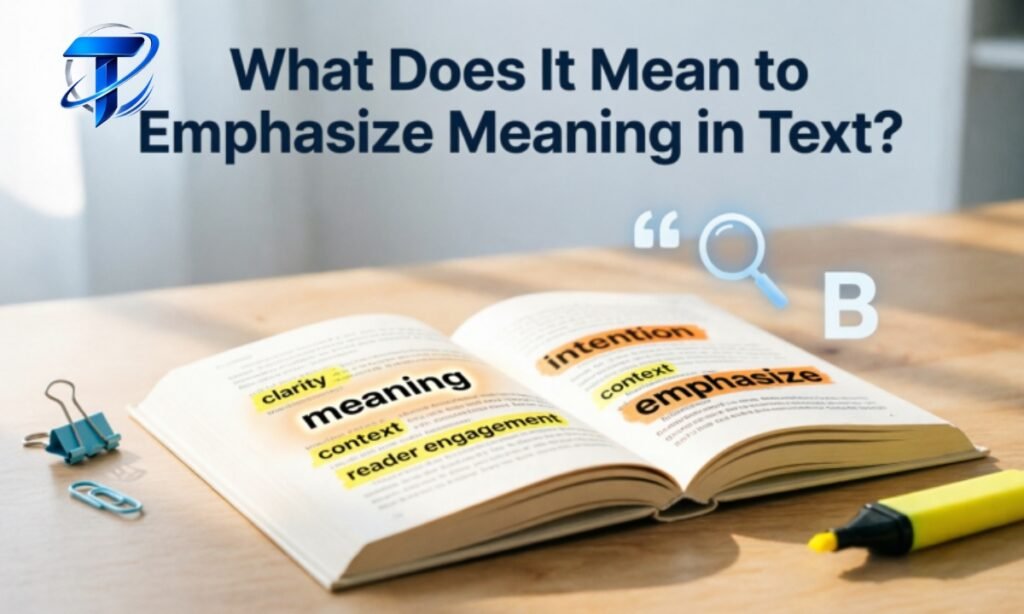
Emphasizing meaning in text means using visual or structural cues, such as capital letters, bold formatting, punctuation, repetition, or emojis, to highlight a specific word, feeling, or point so the reader notices it first.
Since text lacks vocal tone, these visual signals act as a stand in for the emphasis a speaker’s voice would naturally provide. It works the same whether you are texting a friend or writing a formal report, only the tools change.
Read Also : Green Text Meaning on iPhone
Why Emphasis Matters More in Text Than in Speech
When you speak, your voice does the heavy lifting automatically. You slow down, raise your pitch, or pause before an important word without even thinking about it. Text removes all of that. Two identical sentences can be read in completely different moods depending on how the writer chose to format them.
Take this example:
- “Fine.” (read as calm agreement)
- “Fine.” (read as passive aggressive dismissal, depending on context)
The words are the same, but the reader has to guess the tone. That guesswork is exactly why people lean on emphasis. It fills the gap that body language and vocal tone would normally cover, and it helps prevent messages from being misread as cold, sarcastic, or rude when that was never the intent.
Where the Word Comes From
The word emphasize traces back to the Greek term “emphainein,” which roughly translates to “to show” or “to display clearly.” It moved into English rhetoric and formal writing centuries ago as a way to describe stressing a point in a speech or essay. Digital communication borrowed the concept and adapted it for a world of screens, keyboards, and character limits. The core idea never changed. Only the tools used to achieve it did.
Common Ways People Emphasize Meaning in Text
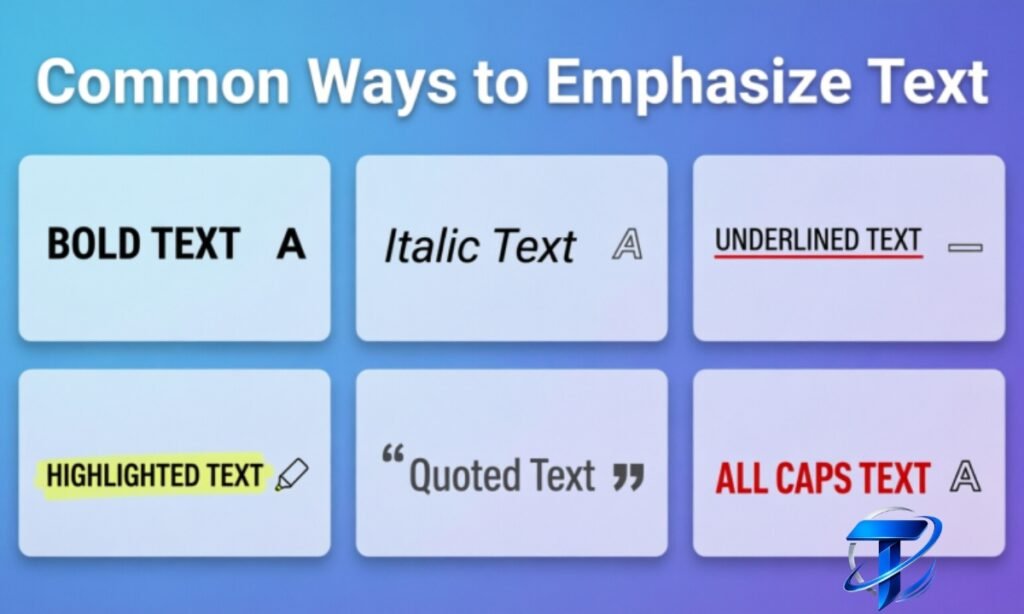
There is no single correct method. Different platforms and situations call for different tools. Here are the most common ones used in 2026.
- Bold text – makes a word visually heavier so it grabs attention first.
- Italics – adds a softer, quieter kind of stress, often used for tone or sarcasm.
- ALL CAPS – signals shouting, urgency, or strong excitement.
- Repetition – stretching or repeating letters and words, like “soooo good,” to show emotional intensity.
- Punctuation stacking – using multiple exclamation marks or question marks for dramatic effect.
- Emojis – add emotional context that words alone cannot always carry.
- Underlining – common in formal writing to mark critical terms or deadlines.
- Hashtags – used on social platforms to flag a keyword as the central idea of a post.
Real Examples of Emphasis in Everyday Texting
Seeing emphasis in action makes the concept easier to apply. Here are some realistic message examples and what they communicate.
| Message | Emphasis Method | What It Signals |
| I REALLY need this by Friday | All caps on one word | Urgency, seriousness |
| I loooove this song | Letter stretching | Genuine excitement |
| Please confirm the meeting time. | Bold text | Formal, important instruction |
| Oh, great, another Monday… | Italics | Sarcasm |
| STOP! Don’t touch that! | Caps plus punctuation | Warning, urgency |
| Thank you so much!! ❤️ | Punctuation plus emoji | Warmth, gratitude |
Notice how the same underlying feeling, whether that is excitement, urgency, or sarcasm, gets expressed through completely different formatting choices depending on the context and the platform.
How Emphasis Changes Across Platforms
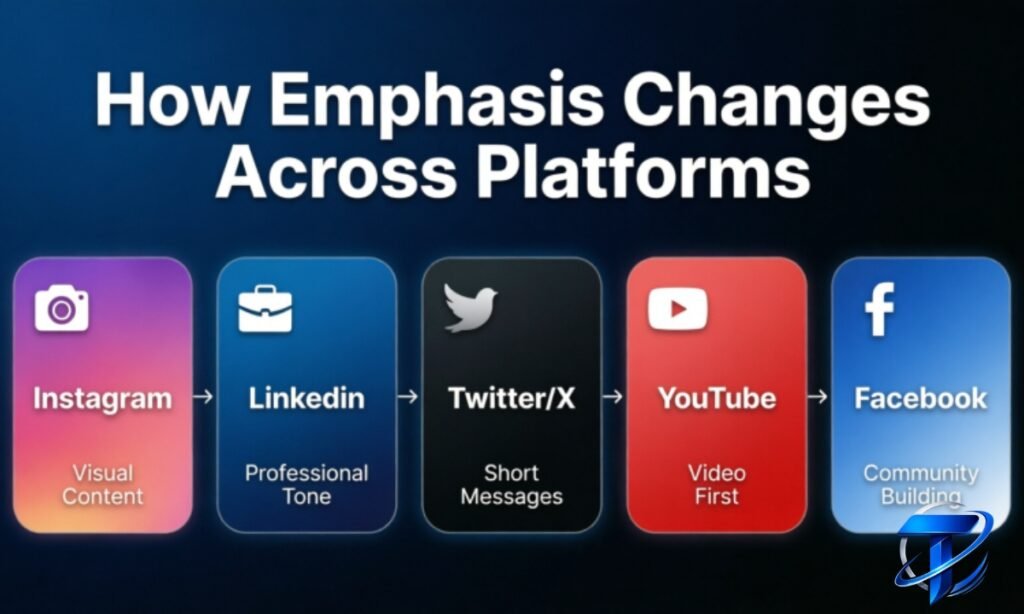
Not every app treats emphasis the same way, and using the wrong style for the wrong platform can make a message feel out of place.
- Text messages (SMS or iMessage): Rely mostly on punctuation, capitalization, and emojis since rich formatting has historically been limited.
- WhatsApp: Supports bold, italics, and strikethrough directly through simple symbol shortcuts, so formatted emphasis is common.
- Instagram and TikTok: Captions often use bold or stylized fonts, emojis, and hashtags to stand out in a crowded, fast scrolling feed.
- Twitter or X: Character limits push people toward short, punchy emphasis, often through caps or a single well placed emoji.
- Email: Bold, italics, and underline are expected in professional messages, while caps and emoji stacking usually feel unprofessional.
Matching your emphasis style to the platform is one of the fastest ways to sound like a confident, natural communicator instead of someone who is overdoing it.
What’s New in 2026: Emphasis in the Age of Rich Messaging and AI
A few real shifts have changed how emphasis works recently, and most guides on this topic have not caught up.
- Rich text in default messaging apps. Both major mobile operating systems have expanded native support for bold, italic, and underline formatting directly inside standard text messaging, not just in third party chat apps. This means fewer people need to rely on all caps or repeated punctuation just to show importance, since actual formatting is now available in more conversations.
- AI writing assistants suggesting tone, not just grammar. Predictive keyboards and writing tools increasingly suggest emphasis choices, recommending a bolded word or a softer phrasing based on the tone of the conversation. This has made emphasis feel more intentional and less like guesswork for casual texters.
- Accessibility awareness is growing. Screen readers often read ALL CAPS letter by letter or announce it as “all capital letters,” which can be jarring or confusing for users who rely on assistive technology. More writers in 2026 are learning to reserve caps for short, essential words rather than full sentences, and to use bold formatting instead when it is available, since it reads more smoothly for accessibility tools.
- Workplace tone guides now cover text emphasis directly. As remote and hybrid work stayed the norm, many companies added explicit guidance on chat and email emphasis to internal communication policies, treating it as seriously as email etiquette used to be treated a decade ago.
Read More : “Hmm” Meaning in Text
When Emphasis Helps and When It Backfires
Emphasis is a tool, and like any tool, it works best in moderation.
It helps when it:
- Clarifies a deadline, instruction, or key detail
- Prevents a message from being misread as flat or cold
- Draws attention to the single most important word in a longer message
It backfires when it:
- Appears in nearly every sentence, which makes nothing stand out anymore
- Uses full sentence caps, which most readers interpret as shouting
- Stacks multiple emphasis methods at once, such as caps, bold, and five exclamation marks together
- Ignores the audience, since a boss or client may read heavy emphasis as unprofessional or aggressive
A simple rule that experienced writers follow: emphasize the one word or phrase that matters most, not the whole sentence.
Emphasis in Formal Writing vs Casual Texting
| Aspect | Casual Texting | Formal or Professional Writing |
| Common tools | Caps, emojis, repetition | Bold, italics, underline |
| Tone | Playful, expressive, fast | Controlled, precise |
| Frequency | Often used liberally | Used sparingly, only for key terms |
| Risk of misreading | Higher, due to informal tone | Lower, but overuse looks unpolished |
| Best practice | Match energy to the relationship | One emphasized term per key idea |
Understanding this difference is what separates someone who communicates clearly across every setting from someone who sounds the same no matter who they are talking to.
Frequently Asked Questions
How do you emphasize meaning in text without sounding aggressive
Choose one method rather than stacking several. Bold or italicize a single important word instead of capitalizing an entire sentence, and save exclamation points for moments that genuinely need them.
Is using all caps always considered shouting
Not always. A short word in caps, like “NOW” in an urgent message, usually reads as urgency rather than anger. A full sentence in caps is far more likely to be read as shouting or hostility.
What is the best way to emphasize something in a work email
Use bold text for the single most important detail, such as a deadline or action item, and avoid caps, emojis, or repeated punctuation entirely in formal correspondence.
Can emphasis change the actual meaning of a sentence
Emphasis does not change the literal meaning of the words, but it changes what the reader focuses on and how they interpret the tone, which can shift the overall message significantly.
Why do people repeat letters like “soooo” in texts
Letter repetition mimics the way a stretched out word sounds when spoken aloud, so it helps convey emotional intensity that plain text cannot show on its own.
Final Thoughts
Emphasizing meaning in text is really about replacing the tone of voice that gets lost the moment a conversation moves from spoken words to a screen. The tools are simple: bold, italics, caps, punctuation, emojis, and repetition, but the skill is in choosing the right one, using it sparingly, and matching it to the platform and the person on the other end.
Get that balance right, and your messages will consistently say what you actually mean, without needing five exclamation marks to prove it.

Matt Henry is a writer and researcher at Trexoleen, specializing in text meanings, slang, abbreviations, acronyms, and modern internet language. He is passionate about making confusing terms simple and easy to understand.


[…] Read Now : Emphasize Meaning in Text […]