

“Writing” is the correct spelling. “Writting” is an incorrect spelling and no dictionary accepts it.
You probably typed it with a double t because it felt right. Plenty of people do. Let’s look at why that happens and how to stop it for good.
Writing or Writting – Quick Answer
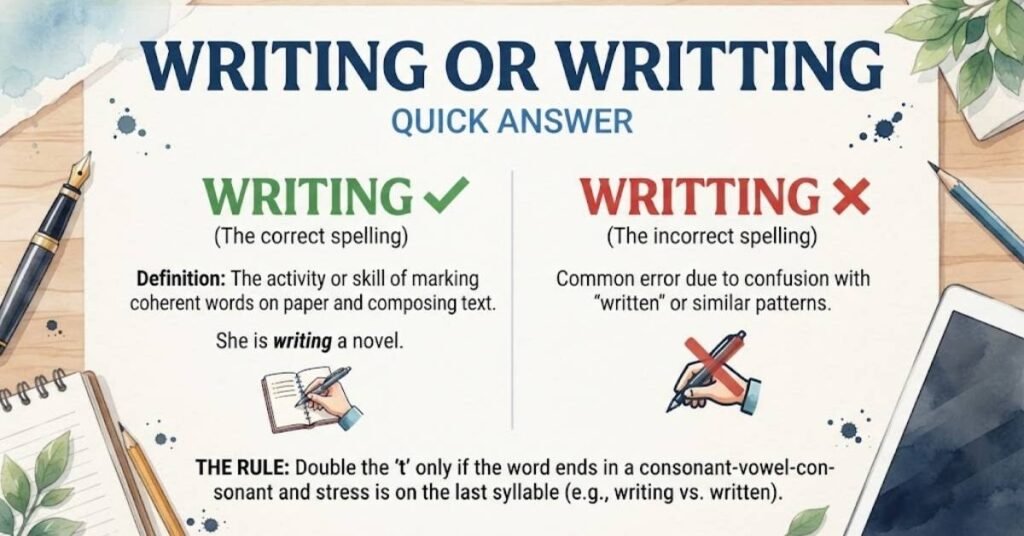
The answer is simple. Writing has one t. Writting has two, and that extra t is a spelling error.
The word comes from the verb write. You add the -ing suffix to make the present participle. Nothing else changes except one letter.
Examples
Here are a few usage examples so the pattern sticks:
- Correct usage: “I’m writing a report for my manager.”
- Correct usage: “She enjoys writing poems on weekends.”
- Incorrect usage: “I’m writting a report for my manager.”
- Incorrect usage: “He loves writting stories.”
If you see two t’s after the i, delete one. That’s the whole fix.
The Origin of Writing or Writting

The word write has deep roots. Its etymology goes back to Old English, where people used writan. It meant to carve or scratch marks into a surface.
That makes sense when you think about early writing. People cut symbols into wood, stone, and metal long before they used paper. The act of writing was physical work.
Over centuries, the meaning widened from carving to creating text with ink and eventually with keyboards. The spelling of the base word shifted too, but it never grew a double t. The “writting” version is a modern slip, not a historical form.
British English vs American English Spelling
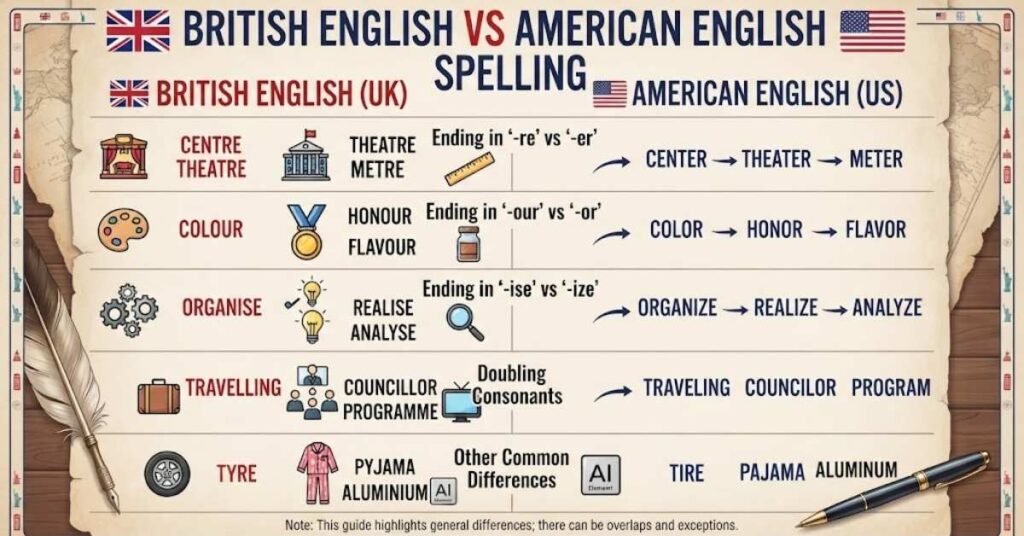
Here’s the good news. There’s no fight between British English and American English on this one. Both use writing with a single t.
Many spelling differences exist between the two. Think of “colour” and “color,” or “centre” and “center.” This word isn’t one of them.
So whether you’re in the United Kingdom, the United States, Canada, or Australia, you spell it the same way. That’s a rare spelling comparison where you can relax. Standard English has one answer here.
Which Spelling Should You Use?
Use writing. Every time. It works in formal writing, informal writing, and everything between.
You won’t find a context where “writting” is acceptable. Not in a text message, not in a legal letter, and not in a novel. Even a character who can’t spell would be better off with a different mistake.
Examples
Check these quick swaps:
- “Creative writing class starts at six.” (Correct)
- “My writing has improved this year.” (Correct)
- “Academic writing needs a clear thesis.” (Correct)
- “Professional writting takes practice.” (Wrong, fix it to “writing”)
If you’re ever unsure, say the word out loud and picture the base word. Write plus -ing gives you writing.
The Spelling Rule Behind Writing
Let’s slow down and look at the actual spelling rules. This is the part that makes the word easy forever.
When a word ends in a silent e, you usually drop the silent e before adding -ing. So write becomes writing. The same rule turns “make” into “making” and “bake” into “baking.”
Here’s a quick write → writing rule you can remember:
- Start with the base word: write
- Drop the final e: writ
- Add the -ing suffix: writing
That’s all the word formation you need. No second t required.
Why the Double T Feels Right
The confusion comes from a different rule. English has a consonant doubling rule, and it’s genuinely common. Words like “sit” turn into “sitting,” and “run” turns into “running.”
The rule says a short word with one vowel and one final consonant often doubles that consonant before -ing. Your brain sees “writ” as a short word and reaches for that pattern. It feels logical, but it’s the wrong tool for this job.
Here’s the catch. “Write” doesn’t end in a plain consonant. It ends in a silent e, so the doubling consonants rule never applies. These spelling patterns compete, and the silent e wins.
Common Mistakes with Writing or Writting
Even confident writers trip on this word. Most of the time, one of three habits is behind it.
Spotting your own pattern is half the battle. Let’s go through each one.
Mistake 1
Doubling the t out of habit. You’ve typed “sitting” and “getting” a thousand times, so your fingers go on autopilot.
The fix is to pause on any word ending in silent e. If it ends in e, drop it and add -ing. Don’t double anything.
Mistake 2
Mixing up “writing” with “written.” This one trips up a lot of English learners. “Written” does have two t’s, and it looks close to “writing.”
They’re different forms. “Written” is the past participle: “I have written three emails.” “Writing” is the present participle: “I’m writing three emails.” Keep them apart and the double t stays where it belongs.
Mistake 3
Trusting a weak spell checker. Some tools miss common misspelling cases, especially in short messages or social posts. Autocorrect can also change a correct word into a wrong one.
Don’t lean on software alone. Reread anything that matters, and check a dictionary if a word looks odd. Merriam-Webster is a solid place to confirm any spelling mistakes.
Writing or Writting in Everyday Examples
Spelling matters in real life, not just in grammar books. Let’s see how this one plays out in the places you actually write.
Picture a small situation. You send a quick note, spot the typo a minute later, and cringe. We’ve all been there.
Your email is often the first impression you make. A typo in the subject line, such as “Writting samples attached,” can make a manager or client wonder how careful you are.
Always proofread the subject line twice. Most emails get skimmed, so a single wrong letter stands out fast.
News
In news and journalism, accuracy is everything. A misspelled word in a headline can hurt trust, and readers love pointing it out.
Editors check these details before publishing for a reason. One tiny slip can overshadow a strong story.
Social Media
On social media, people forgive typos more easily. Still, a post about your blog post or novel with “writting” in it can look careless.
If you’re building a brand or an audience, take ten seconds to check your messages. It costs nothing.
Formal Writing
In a report, a cover letter, or a meeting summary, spelling carries weight. Readers judge your professionalism by small details.
For academic writing and professional writing, there’s no room for “writting.” Proofread, then proofread again.
Writing or Writting – Google Trends & Usage Data
Curious how many people get this wrong? Search data gives a useful clue. When people type a misspelling into Google, it often shows up as a search query worth studying.
Here’s a quick honesty note. I haven’t pulled live numbers for this article, because Google Trends changes constantly. You can check the current figures yourself in a few minutes, and the steps are below.
The general pattern is easy to guess. “Writing” gets far more searches than “writting.” The misspelled version tends to spike when students are doing homework or when people type quickly on phones.
Countries where the query appears often
Misspelling searches usually come from big English-speaking and English-learning markets. Think India, the United States, the United Kingdom, Canada, and Australia. This is worldwide usage, so you’ll see activity across many regions.
To verify it yourself, open Google Trends and compare “writing” with “writting.” Then scroll down to the regional breakdown. It takes about two minutes and gives you real usage data instead of guesses.
Comparison Table: Writing vs Writting
Sometimes a comparison table is the fastest way to see the difference. Here’s everything side by side:
| Feature | Writing | Writting |
| Correct spelling? | Yes | No |
| Part of speech | Noun and verb form (present participle) | Not a word |
| Base word | write | None |
| Rule applied | Drop the silent e, add -ing | Wrongly doubles the t |
| Accepted in British English | Yes | No |
| Accepted in American English | Yes | No |
| Found in dictionaries | Yes | No |
| Safe for formal use | Yes | Never |
Easy Tricks to Remember the Right Spelling
Rules are great, but memory tricks stick better. Try one of these the next time you hesitate.
Trick 1: Say “write, writing” slowly. You hear one t sound, so you write one t.
Trick 2: Remember that written is the only form with a double t. Keep “writing” lean and simple.
Trick 3: Type the word five times in a row. This kind of writing practice builds muscle memory fast. It sounds silly, but it works.
How Better Spelling Improves Your Writing Skills
Good spelling isn’t about being perfect. It’s about making written communication smooth for your readers.
When your words are right, people focus on your ideas. When they’re wrong, readers get distracted, and reader understanding drops.
This matters for students, bloggers, writers, and professionals alike. Clear writing earns trust, and trust earns attention. Strong writing skills start with small habits like this one.
Conclusion
The answer is clear. Writing is the correct spelling, and writting is a spelling mistake. You drop the silent e from write and add -ing. That’s the whole rule.Next time your fingers want a second t, stop and think of “sitting” versus “writing.” Different rules, different words.
A little practice and you’ll never second-guess it.Did this clear things up for you? Drop a comment with another word that trips you up. If a friend struggles with common English mistakes, share this post with them.
FAQs
1. Is writting a correct spelling?
No. Writting is not a word in standard English. The right spelling is writing, with a single t.
2. Why do people spell writing as writting?
Most people apply the consonant doubling rule by habit. They also confuse “writing” with “written,” which does have two t’s. Fast typing makes it worse.
3. What is the rule for writing?
When a verb ends in a silent e, drop the e before adding -ing. So write becomes writing. Short words without a silent e, like “sit,” follow a different rule.
4. Is writing spelled differently in British and American English?
No. Both British English and American English use writing. This word has no regional variation.
5. What does writing mean?
Writing means the act of writing, or the text you produce. It covers articles, stories, emails, poems, and anything else put into words. It can also describe a person’s handwriting style.
6. Is writing a noun or verb?
It’s both, depending on the sentence. In “I’m writing a letter,” it’s the present participle of the verb write. In “Her writing is beautiful,” it’s a noun.

Matt Henry is a writer and researcher at Trexoleen, specializing in text meanings, slang, abbreviations, acronyms, and modern internet language. He is passionate about making confusing terms simple and easy to understand.