
If you have scrolled through a group chat, a gaming lobby, or a Reddit thread lately, chances are you have run into the letters “OP” more than once. Sometimes it praises someone. Sometimes it describes a broken weapon in a video game. Sometimes it points back to whoever started a conversation. The letters stay the same, but the meaning shifts depending on where you see them.
This guide breaks down every common meaning of OP, where the term came from, how it is used across different apps, and how to reply when you spot it in a message. By the end, you will never have to guess what someone meant by “OP” again.
What Does OP Mean in Text? Quick Definition
OP in text usually stands for “Original Poster” or “Overpowered,” depending on context. In forums, comment sections, and group chats, OP refers to the person who started a post or thread. In gaming and competitive talk, OP describes a character, weapon, or move that is unfairly strong.
The Two Core Meanings of OP
OP is one of those rare slang terms that carries two completely separate definitions, and both are still widely used in 2026. Getting them mixed up is the most common mistake people make when reading a chat for the first time.
Original Poster
This is the meaning you will see most often on Reddit, forums, Facebook groups, and even in casual group texts. When someone types “ask OP” or “OP never responded,” they are talking about the person who created the original post or started the thread.
Overpowered
This meaning lives mostly in gaming, esports, and competitive slang, but it has spread far beyond gaming chats into everyday texting. When something is called OP, it means it is too strong, too effective, or almost unfair compared to everything else. A weapon, a character build, a sports play, or even a person’s skill set can be described as OP.
Read Also : WWA Meaning in Text
Where Did OP Come From? A Short History
Understanding the origin of OP makes it much easier to remember which meaning applies where.
- Early 2000s: Online forums and message boards needed a fast way to refer back to whoever started a thread. Typing out a username every single reply was slow, so “OP” became shorthand for Original Poster.
- Mid 2000s: Gaming communities were growing fast, and players needed quick language to complain about unbalanced mechanics. Calling a weapon “overpowered” was accurate but wordy. OP became the faster version.
- Late 2000s to 2010s: Sites like Reddit, 4chan, and early gaming forums helped both meanings spread across the internet at the same time, which is exactly why the confusion still exists today.
- 2010s to now: TikTok, Discord, and Twitch pushed OP into mainstream youth culture, where it picked up a third, softer use as a general compliment for anything impressive.
Both meanings grew side by side rather than one replacing the other, which is why context still matters more than the letters themselves.
OP Meaning by Platform
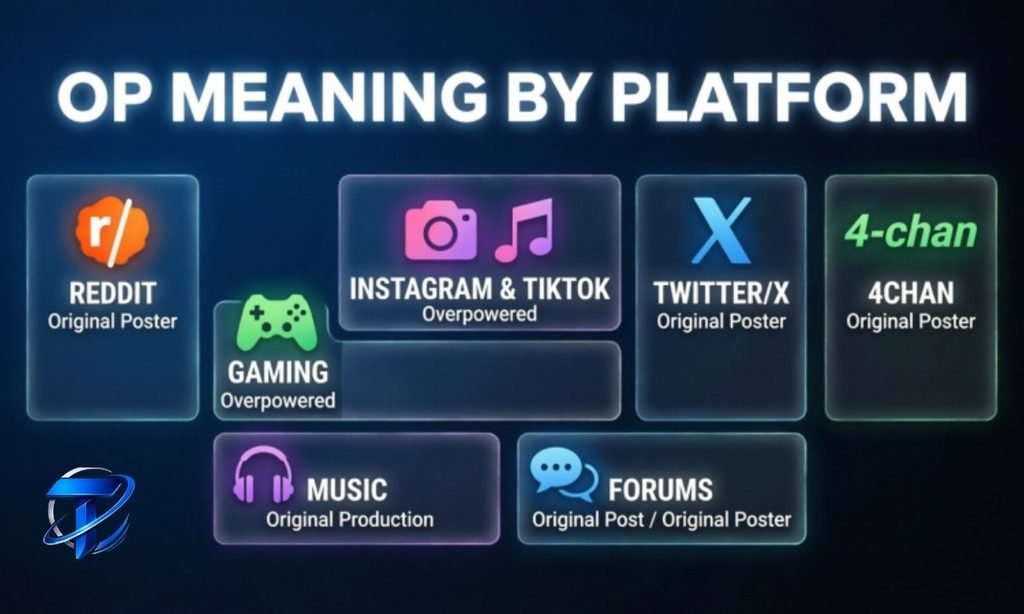
The letters do not change, but the odds of one meaning over another shift depending on the app you are using. Here is a simple breakdown.
| Platform | Most Common Meaning | Example |
| Original Poster | “OP still has not replied to the thread” | |
| Discord (gaming servers) | Overpowered | “This new patch made the sniper way too OP” |
| TikTok comments | Impressive or original poster | “OP really ate with this edit” |
| Instagram comments | Impressive praise | “That fit is OP” |
| Group texts | Original poster or impressive | “OP sent that meme first” |
| Twitch chat | Overpowered | “That combo is OP, nerf it” |
How to Tell Which Meaning Is Being Used
Reading the room takes practice, but there are a few reliable signals that give the meaning away almost instantly.
- Check the topic. If people are talking about games, weapons, characters, or competitive strategy, OP almost always means overpowered.
- Check the setting. If the conversation is about a post, comment, or thread, OP almost always means original poster.
- Check the tone. A short, punchy “OP” attached to praise, like “OP move” or “that’s OP,” usually signals the compliment or overpowered sense rather than a reference to a person.
- Check what comes before or after it. Phrases like “ask OP” or “OP said” point directly to the original poster meaning, since overpowered is never used to describe a request or a statement.
Read Now : JS Meaning in Text
OP as a Compliment: The 2026 Update
One shift that older slang guides tend to miss is how far the compliment usage has spread. In 2026, OP is not limited to gaming anymore. Teens and young adults now use it as a general stamp of approval for almost anything impressive, from an outfit to a dance move to a school project.
- “Your presentation was OP” means the presentation was excellent.
- “That edit is OP” means the video editing was impressively done.
- “Bro’s confidence is OP” means the person is acting bold or dominant, usually said playfully.
This praise usage has become common enough on TikTok and Instagram that it now rivals the gaming definition in everyday texting among younger users, even outside of any gaming context.
OP vs Similar Slang Terms
OP is often confused with a handful of other short internet terms. Here is how they compare.
| Term | Meaning | Typical Use |
| OP | Original poster or overpowered | Forums, gaming, general praise |
| OPP | Opposition or an annoying rival | Street slang, playful teasing |
| OG | Original or highly respected | Praise for something authentic or classic |
| Opp | An enemy or rival | Street slang, hip hop culture |
| Broken | Extremely unbalanced, similar to OP | Gaming |
A quick note on OPP: it is not the same word as OP with an extra letter. OPP comes from African American Vernacular English and street culture, where it usually refers to an opponent or rival, sometimes used lightheartedly among friends and sometimes seriously depending on the relationship.
OP in Professional and Formal Settings
Outside of slang, OP also shows up in professional contexts, and mixing these up with the casual meaning can cause real confusion.
- In accounting and business reports, OP can stand for operating profit.
- In hospital and clinical settings, OP can mean outpatient, referring to a patient who is not admitted overnight.
- In academic planning and scheduling, OP can refer to an operational plan.
These professional meanings rarely overlap with casual texting, so if you see OP in a business email or a medical form, it almost certainly is not slang.
Frequently Asked Questions
Is OP Rude or Offensive?
No. OP is neutral internet shorthand. It is not considered rude, and using it in a casual chat will not come across as disrespectful. The only exception is when someone uses it sarcastically or aggressively, in which case the tone comes from the surrounding words rather than the term itself.
Can OP Refer to a Person Directly?
Yes. In forum and thread contexts, OP refers directly to the person who created the original post. In gaming or praise contexts, calling someone “OP” describes their skill or dominance rather than naming them as the thread creator.
Should You Use OP in Professional Writing?
No. OP is informal slang, and using it in essays, emails, or workplace communication can come across as unprofessional. Stick to the full phrase, such as “original poster” or “operating profit,” in formal writing.
What Does It Mean When Someone Replies “OP” to a Question?
It usually means they are directing the question back to whoever started the thread or conversation, since the original poster is often the person with the most context on the topic.
Is OPP the Same as OP?
No. OPP and OP look similar but mean different things. OP refers to a post creator or something overpowered, while OPP refers to an opponent, rival, or someone causing a minor inconvenience.
Quick Examples to Practice With
- “OP asked a simple question, why is everyone arguing” (original poster)
- “That new update made healers OP” (overpowered, gaming)
- “Not gonna lie, your outfit is OP today” (compliment)
- “Watch out for that guy, he’s an opp” (rival, different term entirely)
Final Thoughts
OP has stayed relevant for over two decades because it does one job extremely well: it saves time. Whether it points to the person who started a thread or describes something too strong to be fair, the meaning almost always reveals itself through context.
Learn to check the topic, the setting, and the tone, and you will read OP correctly every time it shows up in your messages.

Matt Henry is a writer and researcher at Trexoleen, specializing in text meanings, slang, abbreviations, acronyms, and modern internet language. He is passionate about making confusing terms simple and easy to understand.

[…] Read Also : OP Meaning in Text […]
[…] Read Now : OP Meaning in Text […]