
If you spend any time online, in group chats, on Reddit, Discord, or social media, you’ve probably run into the letters NSFW attached to a link, photo, or message. Maybe a friend sent you something with “NSFW” in front of it and you paused before clicking. Maybe you saw it as a tag on a forum post and wondered what it actually meant beyond the obvious guess.
This guide breaks down the full NSFW meaning in text, where the term came from, how people use it across different platforms in 2026, and how you should respond when you see it. By the end, you’ll understand the NSFW meaning in text well enough to use it correctly yourself and to know exactly what to expect before you tap open a tagged message.
What Does NSFW Mean in Text?
NSFW stands for “Not Safe For Work.” It is a warning label attached to text messages, images, videos, or links to signal that the content may be inappropriate to view in a professional, public, or family setting. It usually points to explicit, graphic, violent, or adult material.
That’s the short answer. The NSFW meaning in text hasn’t changed much since the term first appeared, but the way people apply it has grown a lot broader. Below, we’ll walk through the full history, real examples, platform differences, and the small rules of etiquette that come with using this label correctly.
Read Now : BFFR Meaning in Text
Where Did NSFW Come From?
The NSFW meaning in text traces back to the early internet, before content filters, thumbnail blurring, or automatic warnings existed. People needed a fast, typed way to flag risky material before someone opened it in the wrong place.
Here’s a quick timeline of how the term developed:
| Period | What Happened |
| Late 1990s | Offices begin connecting to the internet, and employees start browsing during work hours |
| Early 2000s | Forums, chat boards, and early message boards adopt NSFW as shorthand before links |
| Mid 2000s | Reddit and similar communities formalize NSFW as an official content tag |
| 2010s | Social platforms build NSFW filters, blurred previews, and content warnings into their design |
| 2020s to 2026 | NSFW becomes a universal label across texting apps, Discord servers, dating apps, and workplace chat tools |
The core idea has stayed the same the whole time. Someone types NSFW so the next person can make an informed choice before they open something in front of a boss, a classroom, or a family member. That’s the entire reason the term exists, and it’s still the reason it works in 2026.
Why the NSFW Meaning in Text Still Matters in 2026
You might assume that with AI content moderation, automatic blurring, and platform level filters, the manual NSFW meaning in text label would fade out. It hasn’t. If anything, it has become more common, for a few clear reasons:
- More platforms, more private chats. People now message across a dozen different apps, many of which don’t auto-filter content the way big social platforms do.
- AI generated content. With so much AI generated art, video, and text circulating, people label their own posts NSFW proactively to avoid confusion or takedown flags.
- Remote and hybrid work. With more people working from shared spaces, coffee shops, and open offices in 2026, the NSFW meaning in text warning protects against someone glancing at a screen.
- Community trust. In group chats and servers, tagging content NSFW is treated as basic digital manners, not a technical requirement.
So while the technology around content warnings has changed, the plain-text NSFW meaning in text label is still doing the same job it did twenty years ago, just across more platforms than ever.
The NSFW Meaning in Text Across Different Platforms
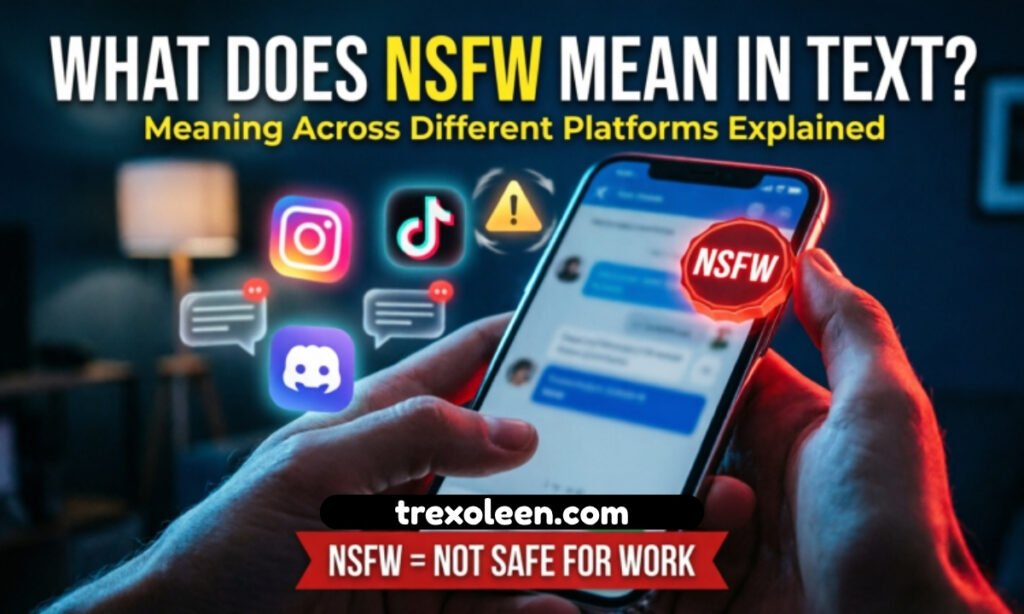
The NSFW meaning in text stays consistent, but the way it’s applied shifts slightly depending on where you see it. Here’s a breakdown:
| Platform | How NSFW Is Typically Used |
| Text messages / iMessage | A heads up before sending a risky photo, video, or link |
| A required tag on posts with adult, graphic, or explicit content | |
| Discord | A channel setting that restricts NSFW channels to verified adult accounts |
| Twitter / X | A content label that blurs images until the viewer taps to confirm |
| TikTok / Instagram | Rare, since these platforms remove most explicit content automatically, but still used informally in captions |
| Snapchat | A quick warning before sending a private snap that isn’t meant for casual viewing |
| Dating apps | A flag for flirtatious or suggestive material, often used to set expectations early |
| Workplace chat (Slack, Teams) | Almost never appropriate, and generally avoided entirely |
Understanding the NSFW meaning in text on each platform helps you avoid two common mistakes: either being too casual with the label somewhere it isn’t welcome, or missing it entirely and opening something you weren’t ready for.
What Does NSFW Mean on Snapchat?
On Snapchat, NSFW carries the same core meaning as everywhere else, but it usually applies to a single snap rather than a whole post. A friend might tag a snap NSFW to warn you that it contains something private, suggestive, or simply not meant to be seen by anyone standing nearby. It’s a courtesy heads up, not a formal content category the way it is on Reddit.
What Does NSFW Mean on Discord?
Discord treats the NSFW meaning in text a bit more formally. Server owners can mark entire channels as NSFW, which restricts access to users who have confirmed their age. Anything posted in those channels, whether it’s art, memes, or discussion, is assumed to fall under the not safe for work label by default.
Is NSFW Only About Sexual Content?
No. This is one of the most common misunderstandings around the NSFW meaning in text. While explicit or sexual material is the most frequent use case, the label also covers:
- Graphic violence or gore
- Strong profanity or offensive language
- Disturbing or shocking imagery
- Sensitive topics like self harm or medical procedures
- Crude humor that could be seen as unprofessional
The NSFW meaning in text is really about context and audience, not one specific category of content. If something would make you uncomfortable if your coworker or grandmother saw it over your shoulder, it probably qualifies.
Read Also : IDM Meaning in Text
NSFW vs SFW: Knowing the Difference
You’ll often see NSFW paired with its opposite, SFW, which stands for “Safe For Work.” Understanding both terms together makes the NSFW meaning in text easier to apply correctly.
| Term | Meaning | Example |
| NSFW | Not Safe For Work, content that may be inappropriate for public or professional settings | An explicit meme, a graphic video, a suggestive photo |
| SFW | Safe For Work, content that is fine to view anywhere | A funny cat video, a normal group chat message |
A quick way to think about it: if you’d feel comfortable opening it on a shared office monitor, it’s SFW. If you’d want to check your surroundings first, it’s NSFW.
Common Examples of NSFW in Real Conversations
To really understand the NSFW meaning in text, it helps to see it used in real situations. Here are a few common examples:
- Sharing a meme: “Sending you this one, it’s hilarious but definitely NSFW.”
- Warning before a link: “Here’s the article, heads up it’s NSFW near the bottom.”
- Group chat context: “Switching topics, NSFW conversation incoming, mute if you’re at work.”
- Art or fan content: “This artist’s page has some NSFW pieces mixed in with the regular art.”
- Dating app messages: “I keep things NSFW free until we’ve actually met.”
In every case, the NSFW meaning in text functions the same way: it’s a small courtesy that lets the other person decide when and where to engage with the content.
How Should You Reply to an NSFW Message?
There’s no complicated etiquette here. A short, simple response works best:
- “Got it, I’ll check it later.”
- “Thanks for the heads up.”
- “Saving this for when I’m not at work.”
You don’t need to explain why you’re waiting, and the sender doesn’t need justification either. The whole point of the NSFW meaning in text label is to remove awkwardness, not create more of it.
Is It Rude to Label Something NSFW?
Not at all. Tagging content as NSFW is actually the polite move. It shows the sender is thinking about the receiver’s environment and giving them control over when to open something. Leaving off the label when it’s clearly needed is closer to bad etiquette than using it.
Can NSFW Be Used Sarcastically or Loosely?
Yes, and this is one of the newer shifts in how people apply the NSFW meaning in text in 2026. Some people tag mildly edgy jokes or slightly awkward content as NSFW even when it isn’t actually explicit, just as a way to add humor or exaggerate for effect. This is common in casual group chats, but it can dilute the label’s usefulness if overdone. If everything gets tagged NSFW, the warning stops meaning much.
Common Misunderstandings About NSFW
Even with how widely used the term is, a few mix-ups keep popping up:
| Misunderstanding | Reality |
| NSFW means the link is a virus or unsafe to click | It’s a content warning, not a security warning |
| NSFW only applies if you have a traditional office job | It applies to any public, shared, or professional setting, including school or family spaces |
| NSFW always means sexual content | It can also mean violent, graphic, or crude content |
| Ignoring the tag doesn’t matter | Ignoring it is exactly how people end up in embarrassing situations |
| NSFW and 18+ mean the exact same thing | NSFW is broader and includes non sexual graphic content, while 18+ is usually specific to adult sexual material |
Related Terms You Should Know
The NSFW meaning in text is often grouped with a handful of similar warning labels. Knowing these helps you read online content more accurately:
- SFW — Safe For Work, the direct opposite of NSFW
- NSFL — Not Safe For Life, used for extremely graphic or disturbing content, a step beyond NSFW
- CW — Content Warning, a broader label for sensitive topics like trauma or mental health
- TW — Trigger Warning, used before content that might cause emotional distress
- 18+ — Indicates content restricted to adult viewers specifically
- Mature — A softer label often used on platforms to indicate adult themed content
These terms often appear alongside NSFW, and understanding the small differences between them helps you gauge exactly what kind of content you’re about to see.
What’s New with NSFW in 2026
A few real shifts have shaped how the NSFW meaning in text gets used this year compared to a few years ago:
- AI generated content labeling. With so much AI generated imagery and video circulating on social platforms, creators increasingly self label AI work as NSFW even before platform moderation catches it, partly to avoid account strikes and partly as a courtesy.
- Cross platform consistency. Messaging apps in 2026 have started adding built in NSFW tagging options, similar to what Reddit and Discord have offered for years, making the label less of an informal habit and more of a built in feature.
- Workplace chat tool policies. Many companies have updated internal chat guidelines in 2026 to explicitly address NSFW content in team channels, reflecting how blended personal and professional messaging has become.
- Younger users and casual use. Gen Z and younger users continue to use NSFW loosely, sometimes for exaggeration or humor rather than a literal warning, which is shifting the term slightly toward general slang while the formal meaning stays intact.
These changes don’t alter the core NSFW meaning in text, but they show the label is becoming more built into digital communication rather than staying an informal habit.
Does the NSFW Meaning in Text Change Based on Who Sends It?
No. Whether a friend, a stranger, a coworker, or someone on a dating app sends it, the NSFW meaning in text stays exactly the same: a warning that the content may not be appropriate for public or professional viewing. The label itself is neutral. What differs is the context around who sent it and why, not the definition of the term.
Is NSFW Still Widely Used in 2026?
Yes, and it remains one of the most recognized labels in online communication. Despite newer slang terms constantly emerging, NSFW has stayed relevant because it solves a simple, ongoing problem: letting people choose when and where to view sensitive content. Its wide recognition across generations and platforms is exactly why it hasn’t been replaced.
Quick Reference: NSFW Meaning in Text Summary
| Question | Answer |
| What does NSFW stand for? | Not Safe For Work |
| Is it only about sexual content? | No, it also covers violence, graphic imagery, and strong language |
| Is it rude to use? | No, it’s considered polite and considerate |
| Does it mean a link has a virus? | No, it’s strictly a content warning |
| Is it still common in 2026? | Yes, and its use has expanded across more platforms |
Final Thoughts
The NSFW meaning in text comes down to one simple idea: it’s a warning, not a judgment. It exists to give people control over what they view and when, whether that’s in a work meeting, a classroom, or just sitting next to family. Understanding the NSFW meaning in text properly means knowing it covers more than sexual content, applies across nearly every platform you use, and works best when it’s used honestly rather than as an exaggeration.
Next time you see NSFW attached to a message, you’ll know exactly what it’s telling you, and next time you’re the one sending something risky, you’ll know to add the label yourself. That small habit is really all the NSFW meaning in text has ever been about.

Matt Henry is a writer and researcher at Trexoleen, specializing in text meanings, slang, abbreviations, acronyms, and modern internet language. He is passionate about making confusing terms simple and easy to understand.

[…] Read More Meanings […]